Wall Tablet
The whole day, on the wall, without asking.
Overview
A wall-mounted Android dashboard for one home office. Landscape, always on, glanceable from across the room: calendar, weather, the grocery list, days-since trackers, trash day, and the temperature of the room you are actually sitting in. Built to still be working, untouched, in three years — which turns out to be a design constraint rather than a wish.
General Note · The Problem
The information I check ten times a day lives in six apps on a phone I have to pick up, unlock, and open. A wall display should just show it. But every option is a bad trade: the consumer smart displays are locked down and full of things I did not ask for, the DIY ones are a maintenance project, and all of them fail the same way — a spinner, an error page, or a blank screen, on the one device nobody looks at critically enough to notice it has been wrong for two days.
Built For
One person, one wall. Someone who will happily wire an ESP32 to a sensor but will not babysit a Raspberry Pi, and who wants the thing to keep working while they ignore it for a year.
Schedule · Key Features
6 ItemsOne glance, no interaction
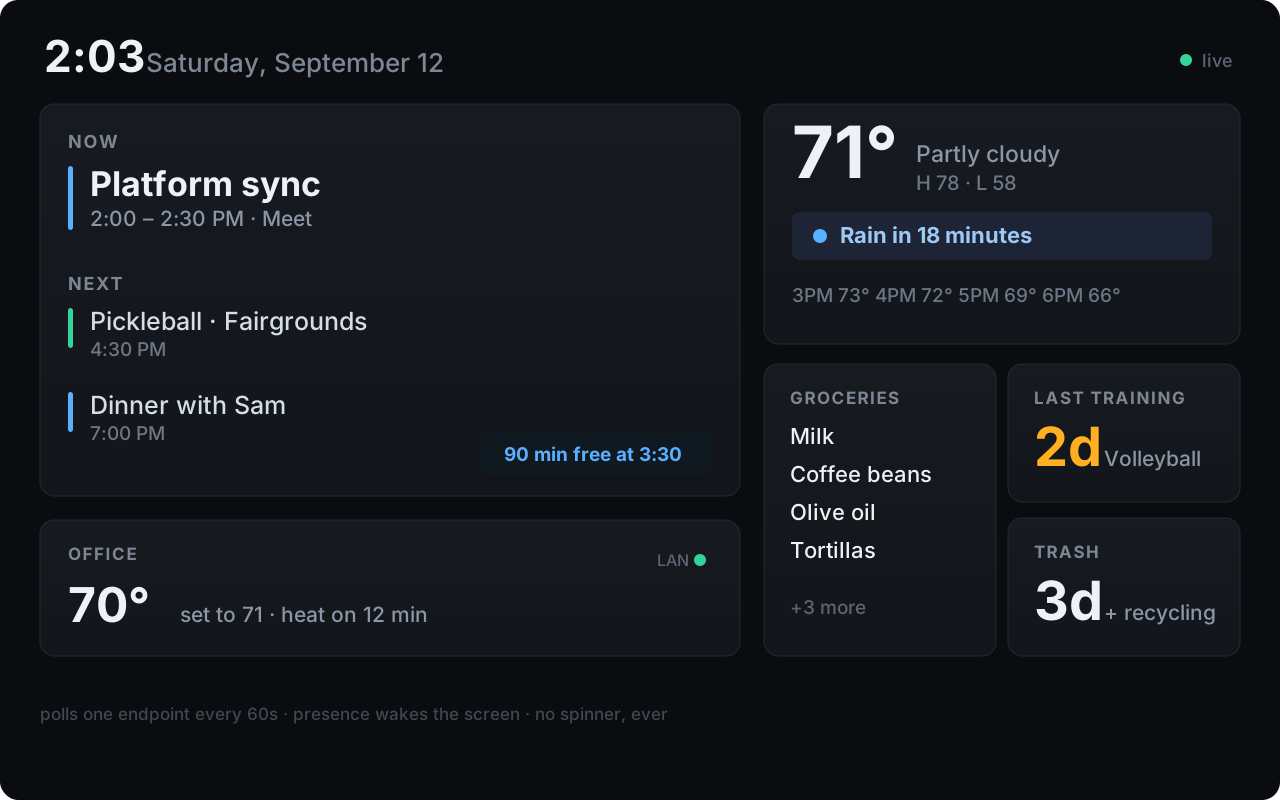
Two Google calendars merged into one strip, the next free block computed for you, rain in the next hour to the minute, what is on the grocery list, and how many days since the last workout. Exactly three screens you can drill into; the failure mode of 'fully interactive' is building twelve detail screens and using two.
Never a spinner, never a blank screen
A failing source grays out its own tile, keeps its last known value, and shows how stale it is. Everything else keeps rendering. A wall display is only noticed when it is wrong, so the one thing it must never do is look confident while serving a two-day-old calendar.
No secrets on the wall
A scheduled Lambda holds the OAuth refresh tokens, calls every upstream, merges one JSON document and writes it to DynamoDB; the tablet knows one endpoint and one shared key. Fixing a broken Google integration is a deploy, not sideloading an APK off a ladder.
Wakes when you walk in, not when you wave
An $8 mmWave sensor on the LAN detects a stationary human through chest movement, so the screen does not drop you the moment you stand still reading it — which is exactly what a PIR sensor does. Local only, so presence keeps working during an internet outage, with a time-of-day fallback so a dead sensor never leaves a black wall.
Doorbell in under a second, with no cloud
Blink has no public API and the unofficial clients poll, which means 10 to 30 seconds on a someone-is-at-your-door event. Reading the Blink app's own Android notification on the tablet is sub-second and has nothing to break. It is a hack, and it is more reliable than the alternative.
Actually free, arithmetic included
Under $0.25 a month, which was checked rather than assumed. Two Go Lambdas on arm64, a DynamoDB table, an EventBridge schedule. Go because a Lambda you deploy today still builds unchanged in three years, where a Node one has a dead runtime and a wall of audit warnings.
Voice · How It Talks
Rain in 18 minutes
The single most useful line on the screen, and it is free — the same forecast call already returns 15-minute precipitation. Specific enough to change what you do in the next hour.
Last updated 82 min ago
Not 'Something went wrong.' The tile keeps its last real numbers, dimmed, with the age climbing. The one exception is a dead Google token, which renders loudly, because it is the only error that will never resolve itself.
Last training · 2d · Volleyball
Mild, persistent, non-nagging guilt. Amber at three days, red at six. It counts playing your sport, because the app it reads from counts it, and a dashboard that contradicts its own source is worse than a lenient one.
Comparison · Why It Wins
- Degrades instead of failing — every competitor eventually shows a spinner, a reload button, or a blank panel; here a dead source is a dimmed tile with its last value and an age
- Refresh tokens live in AWS, not on a device screwed to a wall — the tablet holds one shared key and knows one URL
- Free without a subscription — DAKboard puts the genuinely useful features behind a plan; this is under $0.25/month of real AWS bill
- No server to maintain — MagicMirror² and Home Assistant dashboards are excellent and are also a Raspberry Pi you now own forever
- Presence that survives standing still — mmWave rather than PIR or a camera, local to the LAN, working in the dark and during an outage
- Sub-second doorbell with no cloud integration, by reading the camera app's own notification rather than polling an unofficial API
- Deliberately single-user: no settings screen, no theming, no second account — the scope that makes three-year unattended operation plausible