
Tadaima ただいま
Learn the Japanese your family speaks
Overview
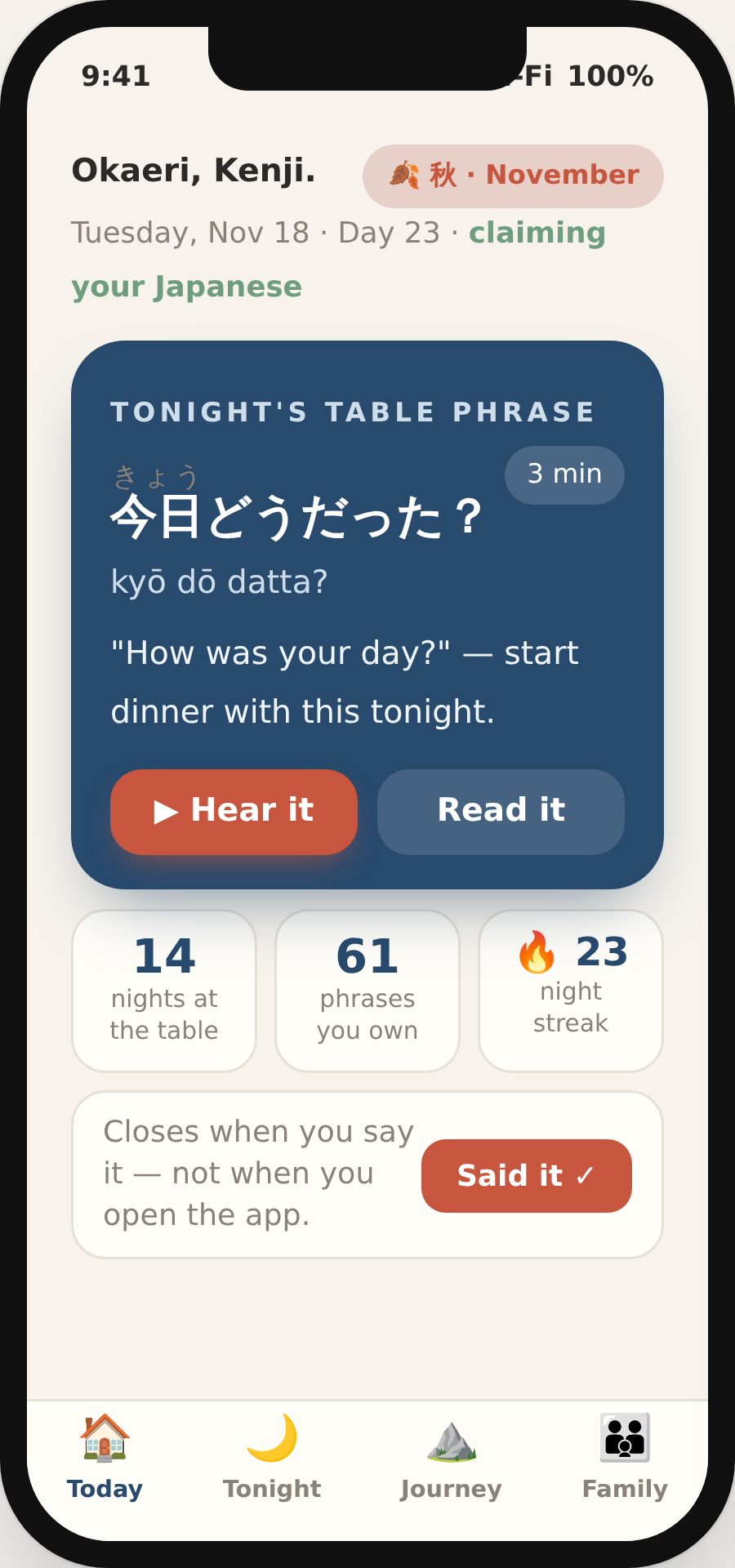
A conversation-first Japanese app for heritage learners. Instead of a robot chatbot, it's built around the native speaker you already have at home — giving you one small thing to say at dinner each day — and the relatives you want to understand on your next visit.
General Note · The Problem
I'm half Japanese. I grew up around the language — relatives in Yamagata, Japanese spoken at home sometimes — but we always defaulted to English, and here I am. Every app I've tried is built for tourists, anime fans, or JLPT test-takers, and I quit all of them. What I actually want is to hold a real conversation with my family.
Built For
Heritage learners with a Japanese family member at home — people who want family connection, not a test score.
Schedule · Key Features
5 ItemsThe table is the lesson
Activates the native speakers already at your table. Each day gives you one un-awkward thing to say at dinner and gently opens the door to a reply in Japanese — real native interaction from day one, no robot.
Ears before eyes
Listening-first: you hear every phrase in a real voice before you ever see it written. Kanji and reading come later — understanding family at the table comes first.
The road to Yamagata
Every phrase ladders up to a concrete, emotional goal: the next reunion. A countdown and per-relative goals turn abstract 'study Japanese' into 'be ready to talk to Grandma.'
Progress you can feel
No points or leaderboards. It counts real conversations had and things you understood — engineered for the month-3 'valley of despair' where motivated learners usually quit.
The right register
Casual warmth at home, gentle keigo for older relatives. Teaches the politeness levels that actually matter for family — the part textbooks and tourist apps skip.
Voice · How It Talks
You heard Japanese from birth. Then life happened. That's fine — let's find out what you actually know.
Meets the heritage learner where they are — not a blank-slate beginner, not behind. Claiming, not acquiring.
You got a reply in Japanese — and notice the dropped は. That's how real family speech sounds.
Rewards a real exchange, not a drill, and teaches the casual register textbooks skip.
Missed a day. Tomorrow's phrase is already picked. The streak counts the nights you showed up.
No owl, no guilt. A repairable, low-stakes streak is built to survive the month-3 valley where learners quit.
Comparison · Why It Wins
- Built for heritage learners (family connection), not tourists, anime fans, or JLPT test-takers
- Uses the learner's own family as native-speaker practice — the one thing no app can replicate
- Listening/speaking-first instead of text/reading-first — matched to the real goal of talking
- Progress measured in real conversations, not streaks — designed to survive the month-2-to-4 dropout window
- Grounded in language-acquisition research (comprehensible input, SRS at 85–90%, Fogg habit model)